HKDSE · Paper 1 Reading
DSE Reading | Years of tutoring, still no results
A case study of mindless drills, and the way through them

The case: so much practice, and nothing moves
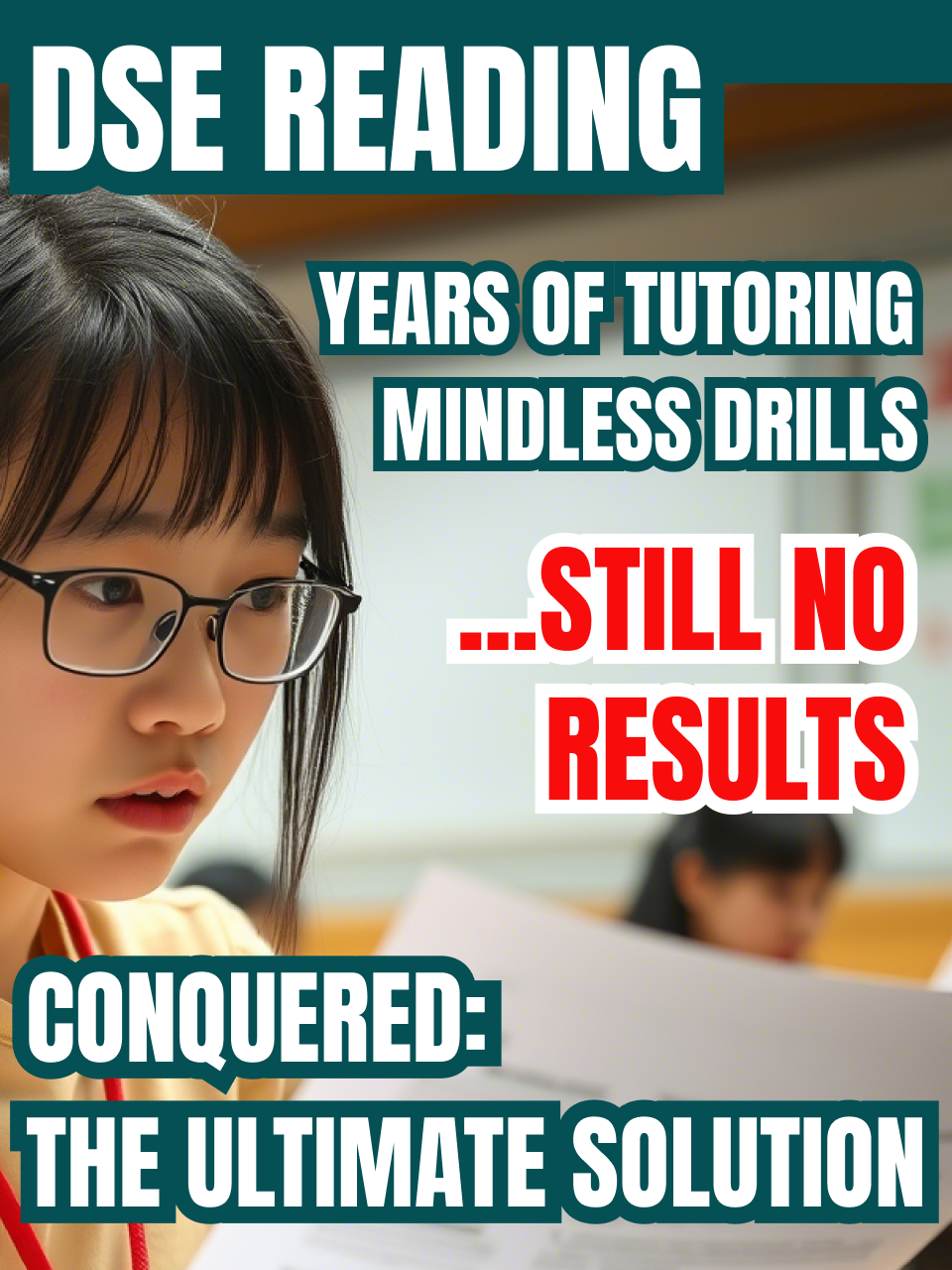
“I’m in Form 4. We drill reading papers at school, and the teacher does teach the skills. I drill them again at tutorial. It still doesn’t work. Why?”
That is the story EHLA hears most. Parents see a timetable full of papers. Students see a thicker book of wrong answers. The mark stays flat, or slips. The effort is real. The direction fights the way reading ability actually grows.
This note starts from that case. It sets out why tutorial drilling so often fails, and how EHLA rebuilds a path with paragraph analysis, error coaching, a vocabulary system, cross-paper topics, and Reading Skills Focus.
See the paper clearly before you blame the method
| Time | Length | Questions |
|---|---|---|
| about 90 minutes | 2,200–2,400 words | 45 to 52, real comprehension |
Keyword-hunting will not carry it. It is dense information plus critical reading.
The sharp end is B2: prose in the range of The Economist, with metaphor, the argument style of a journal, and the voice of a professional report. Students have to understand and infer a great deal, very quickly. If the vocabulary and the long sentences are not there yet, every timed paper is another rehearsal of failure, not a skill they can take to the next text.
EHLA’s first diagnostic rule: admit how hard the paper is built to be. Otherwise “the foundation isn’t there” gets misread as “they don’t know the tricks”.
Why the tutoring never takes
- The student cannot absorb what the lesson is offering. If too many words and sentence shapes are strange, more practice does not train strategy. Each paper feels like noise. If nobody then goes and learns the new words, the student is standing still. They do not know what the practice is for. That is not learning, however many hours it fills.
- Long sentences will not open, even when a few advanced words are known, and the paragraph collapses.
- They are too slow to finish.
- The tutorial itself cannot go deep. After the paper, almost nobody analyses that student’s actual thinking. Even one-to-one, a teacher rarely has time to digest a full DSE passage and every question, then coach properly.
- They are worn out. Long texts and huge question counts turn English into something to fear, and fear kills the habit.
Stack those five, and “school drills plus tutorial drills” can still produce zero progress.
Too few words, and reading strategy has nothing to stand on
Students look for a shortcut, and most of them already know the truth: more words would change their reading. Memorising is tiring, so they circle. EHLA will not soften this. Without the vocabulary, a student is sitting a dense paper half-literate in it. There is no reading improvement to discuss until that changes.
The gap is large. Many Chinese-medium students enter Form 4 somewhere around 2,500 to 4,000 words. A steadier Paper 1 score asks for far more passive vocabulary, and a higher target asks for more again. Doing papers, checking keys, and memorising skill slogans, on a foundation that is not there, is building another floor on an unfinished base.
The order is simple. Vocabulary first, then technique and speed. EHLA’s vocabulary system — tracking, review, memory management, a daily check-in — exists to cut the loop of “avoid the words, drill anyway, avoid them again”.
Two targets, not one: local Part A and international B2
Another reason the drills fail is that Paper 1 gets treated as one question factory. The two parts are not the same subject.
Part A is Hong Kong. Part B2 looks outward, often in the voice of The Economist, The New Yorker, The Atlantic, The New York Times, or The Guardian. Drill one difficulty and one topic type forever, and you build neither local depth nor the muscle for advanced international prose.
EHLA sets the work on two tracks. The local track feeds reading and writing topics. The international track feeds B2 comprehension and advanced vocabulary. For a student who has practised for years with nothing to show, this is aiming at the right target instead of adding more hours in the dark.
Solution one: B2 reading, paragraph analysis, error coaching
The pain in the case is “I finished the paper and nobody actually taught me”. EHLA answers with a B2 programme built by teachers trained in English literature at Cambridge and a research team in the Oxford linguistics tradition. The prose models are The Economist, The Guardian, Time, The Times, and The New Yorker. Themes and questions are chosen and worked until they sit close to B2. Stronger students can take a heavier version.
The teaching engine is paragraph analysis and error coaching. Difficult paragraphs are opened so metaphor, tone, and argument can be seen. Error coaching does not hand over the key. It shows how to reason to the best answer while English is still limited. The density is meant to match a Band 1 teacher who has actually prepared.
That is also why traditional reading tuition costs what it costs. Preparation, sitting the paper, marking the thinking, and coaching the error can take hours. EHLA makes that sequence something a student can repeat, without depending only on an expensive hour.
Solution two: cross-paper topics, and Reading Skills Focus
A second blind spot is preparing reading and writing as if they were unrelated. Part A is about Hong Kong. So is much of Paper 2. If local issues are a blank, reading stays on the surface and the long essay has nothing in it. EHLA takes current writing themes and rebuilds them as Part A tasks, so close reading is also a store of material and depth for Paper 2.
When time is broken and concentration is short, Reading Skills Focus is the short form: passages cut by question type or skill — figurative language, metaphor and irony, and so on — so one sitting trains one skill, at a chosen level.
EHLA is not romantic about the short form. It has a use, and a large limit. It does not replace reading a whole text. It stops a bleed and sharpens a skill. It is not an excuse to avoid long reading, or the old cycle returns: busy, and empty.
From useless drilling to practice that teaches
Back to the Form 4 student: school drills, skills lessons, outside tutorials, no result. EHLA does not add another paper. It reorders the work.
- Vocabulary first, so reading is no longer half-blind.
- Then paragraph analysis and error coaching, so each mistake becomes reasoning they can keep.
- Then B2 texts for the international track.
- Then cross-paper topics for local issues and writing material.
- Reading Skills Focus comes last, as acceleration, not as the whole plan.
Useless drilling tests failure before the student can succeed. Useful practice sits where they can reach the text, learn from it, and see why they were wrong. That is the method EHLA has taken into Hong Kong schools for years: the base before the speed, the text before the trick, the diagnosis before the programme.
When practice becomes a loop with feedback, a stuck mark can finally move. That is the way through “years of tutoring, still no results”.
Who wrote this: EHLA
Rooted in Oxford.
EHLA studies what actually changes English learning, then turns that research into programmes schools and students can run. We work with individual learners and with mainstream Hong Kong schools. More than 300 schools have taken part in EHLA pilot programmes.
“My colleagues at the University of Oxford and I met EHLA in Oxford, and I was completely fascinated by what EHLA is doing…” — Prof. Furlong, former Dean of the Department of Education, University of Oxford