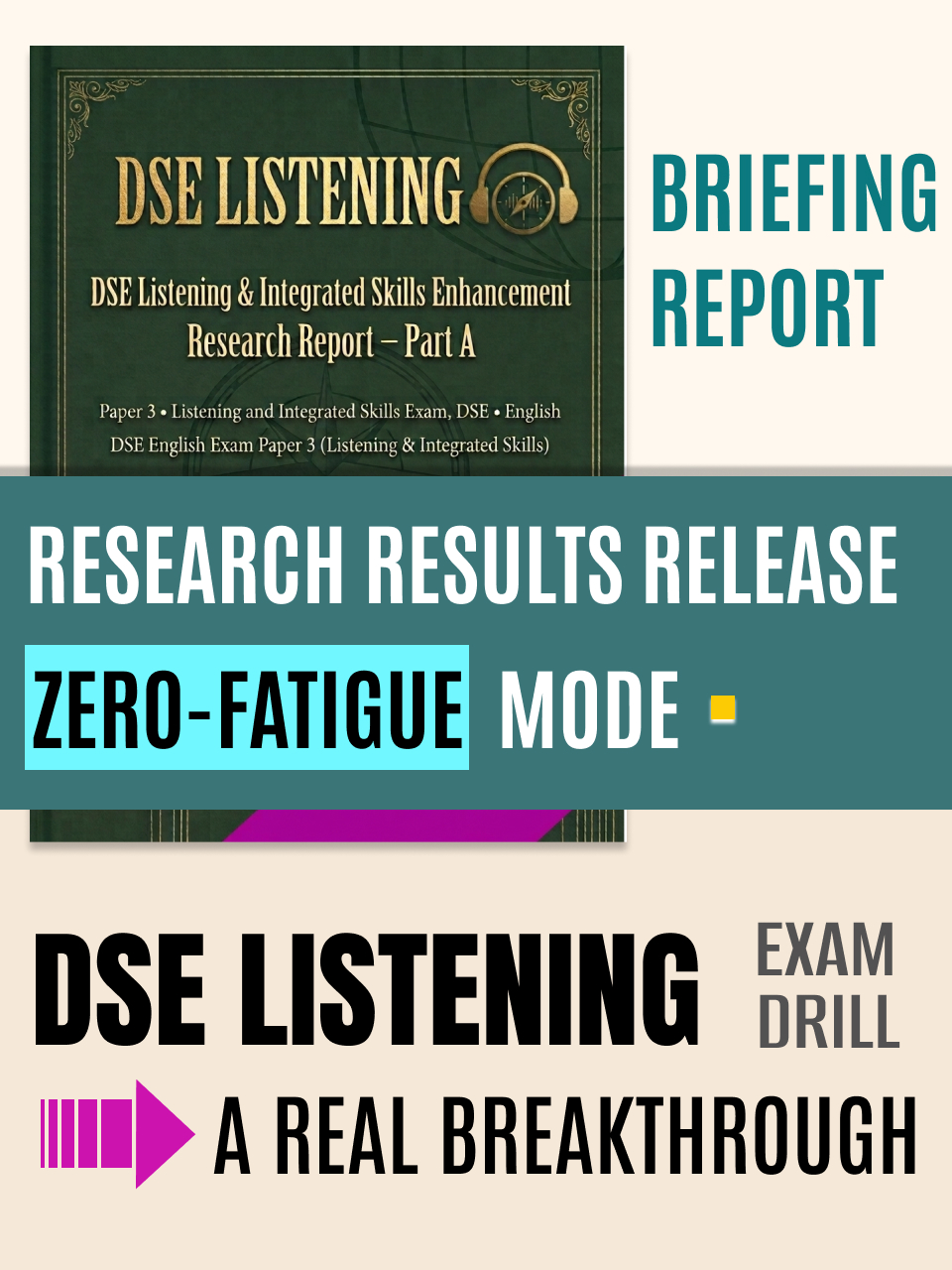
HKDSE · Paper 3 Listening
DSE Listening | Zero-Fatigue Mode: a real breakthrough
Paper 3 Part A briefing · the research, and the full-navigation solution

Why ordinary DSE listening prep makes students quit
Part A of HKDSE English Paper 3 (Listening and Integrated Skills) is the part candidates dread most, especially in Chinese-medium schools. It is also the part they are quickest to abandon. On paper the plan looks simple: listen more, write more, grind past papers. In practice that plan usually collapses within weeks.
A full DSE listening task is long and exhausting. Students have to follow the recording, take notes, and spell accurately, all at once, without a break in concentration. For most of them it is not training. It is a repeated proof that they cannot hear it, cannot spell it, and cannot keep up. They start avoiding practice. Less practice means less exposure to the scenes and the words. The spiral tightens.
EHLA has spent years studying how Part A is prepared, how efficient that preparation is, what keeps students going, and what actually removes the blocks. This briefing is the short version. The listening problem is rarely “not working hard enough”. It is a mismatch between how the paper is taught and how listening actually works. Zero-Fatigue Mode — EHLA’s full-navigation listening — turns that high-pressure drill into something students can repeat without burning out.
Three myths that keep listening teaching stuck
Myth one|more full mocks equal better preparation
In second-language learning, input far beyond what a student can understand does not sink in. It locks in the feeling of failure and raises the affective filter, so the student wants the listening even less.
Myth two|exam tricks will carry a weak listener
Prediction, shorthand, and distractor-spotting matter, but only when working memory still has room. If the student cannot yet tell what the scene is about, or what the target words are, the tricks are a match in fog.
Myth three|it only counts if the student writes every answer
That confuses performance with learning. Under high anxiety, forced spelling eats the attention that should be on the next stretch of speech. EHLA treats watching and staying inside the task as real learning. For a struggling student it is how the door opens again. For a strong student it is a fast way to see the gaps.
The floor under listening: schema, vocabulary, spelling on the spot
Listening is not “hear a sound, translate a meaning”. It is a two-way process: expectations from background knowledge (schema) meeting sounds and words coming up from the recording.
Part A jumps across a very wide set of scenes, and it assumes a life most Chinese-medium students have not lived: wildlife conservation, overseas volunteering, green architecture, city planning, festival production. That gap in experience is why so many students lose the thread. Avoiding practice makes the gap worse. Without the scene, there is no floor to stand on.
Two skills sit on that floor and cannot wait: listening vocabulary, and the ability to spell those words while the recording is still moving. No schema, and the background never lands. No vocabulary, and the answer points never land. Slow spelling, and the hand cannot keep up. Any one of those failures knocks the next one over, and the exam tricks fail with them. EHLA’s order of work is deliberate: rebuild the scenes, rebuild the listening vocabulary, then turn words the ear knows into words the hand can write.
Zero-Fatigue Mode: watch the paper being solved, without the panic
In Zero-Fatigue Mode a session can be as short as four to eight minutes. The student hears the script and watches the task move, but does not have to write. The system walks the whole paper: prediction, shorthand, cutting distractors, then locking the answer.
An instant-commentary layer can run at the same time, explaining why that answer, and marking the line in the subtitle that points to it. Bilingual subtitles are optional. The point is to drop the emotional load so attention stays on three things: hearing it, lining it up with the question, and seeing the logic.
Students can switch modes. Zero-Fatigue Mode is the full worked example. Normal mode is the real attempt, handwritten and submitted as usual. For a weak student the first mode is a lifeline. For a strong student it is a fast audit. It also drops the old rule that listening practice is either a test or it is nothing. Watching the paper, and staying in it, is itself the work.
Ten design rules for a listening system people will actually use
EHLA built this outside the ordinary classroom drill, around ten rules.
- Step outside the usual lesson shape and make a listening system people can live in.
- Show the whole solution, so students can watch the thinking with the pressure off.
- Let them choose Zero-Fatigue Mode: listen and watch, no writing required.
- Keep each session to a few minutes. It should not exhaust anyone.
- Make it feel like something you can finish, so “listening is manageable” replaces the nightmare.
- Cover the spread of DSE scenes, not a narrow slice of them.
- Stay 100% DSE: question types, pace, and logic.
- Turn abstract listening tricks into steps you can see.
- Offer a hint on the spot, so “I didn’t catch that” does not become a ten-minute dictionary hunt.
- Track the words the ear met, then follow them with handwriting practice.
These are not features piled on for show. They answer one problem: students have to be willing to enter DSE listening again and again. Until that door opens, improvement is theoretical.
Three modules: micro-skills, mocks, and a fast vocabulary bank
Module 1|DSE micro-skills
Four to eight minutes, one skill at a time, short enough to watch and copy.
Module 2|DSE mock training
A full Part A task, with the paper’s question types, speed, and scene logic. Switch between the guided walkthrough and a real attempt.
Module 3|a fast listening-vocabulary bank
Aimed at the failures that actually cost marks:
- Spelling and look-alike traps
- Dropped modifiers
- Noun and noun-phrase traps
- High-frequency verbs and phrases
- Topic language
- A memory bank of words the student looked up
Plural forms that change meaning (authority / authorities) are a typical example. Recognition review and short spelling drills run side by side.
If a word is new, in the question or the subtitle, one tap defines it. After the walkthrough, the answer phrases can be pulled into spelling practice. The system remembers both the answer words and the words the student checked. Nothing seen in the low-pressure mode is left as “I watched it, so I must know it.”
What changes: less dread, then a real map of the scenes
The first gain is psychological. In a lighter session, students can start to believe that listening is not a punishment. The old fears — I can’t hear it, I can’t spell it, I can’t keep up, it takes forever — lose their grip.
Motivation has to come back before the habit can. Only then does the wide map of DSE scenes actually get built. That map is exactly what grind-until-you-drop practice almost never produces. EHLA turns the grind into short sessions: effective, and light enough to repeat.
Zero-Fatigue Mode, plus short spelling follow-up and automatic tracking of weak spellings, is a lifeline for struggling students and a fast gap-check for strong ones. The longer research report — Volume 1: Diagnosis, and Volume 2: Breakthrough — sets out the full picture and the evidence behind it.
Who wrote this: EHLA
Rooted in Oxford.
EHLA studies what actually changes English learning, then turns that research into programmes schools and students can run. We work with individual learners and with mainstream Hong Kong schools. More than 300 schools have taken part in EHLA pilot programmes.
“My colleagues at the University of Oxford and I met EHLA in Oxford, and I was completely fascinated by what EHLA is doing…” — Prof. Furlong, former Dean of the Department of Education, University of Oxford